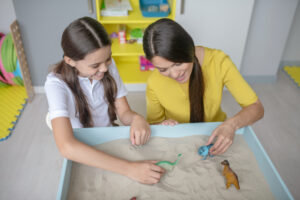
Kids can express their feelings in very different ways than adults do. They might act out or shut down, or even possibly say “I don’t know” when asked how they feel. Sand tray therapy can help give kids a less threatening way to communicate their feelings. It gives children a way to express emotions without having to find the words.
Understanding what the problem really is can quickly become extremely challenging. Childhood behavior can overlap with many emotional and developmental challenges. Professionals also take time to carefully evaluate long-term patterns of mood and behavior, which is part of the bipolar disorder diagnosis timeline that can be tricky to diagnose in kids and young adults.
Sand tray therapy fits into this bigger picture by giving kids a safe, creative way to communicate what they can’t say out loud. Let’s look at five common signs your child may benefit from it.
1. Your Child Struggles To Talk About Feelings
Children can struggle to find the right vocabulary to communicate feelings. It can be very easy for them to shut down or become overwhelmed quickly. Sand tray therapy allows them to “show” what they feel using miniatures and scenes. This removes pressure and helps emotions come out naturally through play rather than conversation.
Example: A child who cannot explain why they feel angry at school might build a sand scene in which a small figure is “stuck” in a broken house while another figure stands alone outside.
2. Inconsistent Emotional or Behavioral Symptoms
Does your child seem fine, and the next day, they are extremely reactive? You might notice sudden mood shifts, irritability, or withdrawal without a clear reason. This is often where things can become complex clinically, because symptoms may overlap with anxiety, ADHD, or depression. In more involved cases, clinicians carefully track patterns over time, especially when considering broader mood-related conditions.
The bipolar disorder diagnosis timeline can take time because professionals need to see how symptoms develop across different settings and situations before drawing conclusions. Sand tray therapy can help reveal emotional themes that might not be obvious in everyday conversation.
Example: A child who is experiencing inconsistent emotional or behavioral symptoms might start having frequent, unexplained stomachaches or headaches to avoid going to school.
3. Difficulty Coping With Stress Or Changes
Big life events can have a much bigger impact on children. Some of these examples include dealing with divorce, moving to a new city/location, losing a loved one, or changing the regular routine. Some kids are more resilient than others, but it’s not uncommon for a few kids to have a hard time “bouncing back” after a life change or traumatic event. You might see regression, increased anxiety, sleep issues, or clinginess.
Sand tray therapy gives children a sense of control during uncertain times. Through play, they can recreate experiences that help them process and make sense of what’s happening.
Example: A child going through their parents’ divorce might place two separate houses on opposite sides of the sand tray and create a figure that moves back and forth between them. This can get to the root cause of how the child feels without using words.
4. Trouble With Focus Or Emotional Regulation
For some children, it’s very difficult for them to stay on task or follow even simple instructions. They could also become overwhelmed and frustrated, even over something minor. These behaviors can sometimes resemble ADHD, anxiety, or mood-related concerns, which is why careful evaluation is important. According to the NIMH (National Institute of Mental Health) and Mayo Clinic, clinicians rely on detailed clinical interviews and long-term observation to differentiate between overlapping conditions and understand what’s really driving behavior.
In therapeutic settings, sand tray work can help children externalize what they’re feeling internally, making it easier to identify emotional triggers and patterns.
Example: A student in a classroom becomes easily frustrated when asked to complete a simple worksheet. They become frustrated within a few minutes, start fidgeting, leave their seats repeatedly, and then melt down when the teacher redirects them. They might use figures to show themselves struggling at a desk, while other characters represent distractions or overwhelming feelings.
5. Your Child Feels Disconnected Socially
Does your child avoid peers or fail to make attempts to hang out with friends? It might be a sign they are struggling internally. It may be very difficult to express sadness or fear in healthy ways, which ultimately leads to isolation and conflict. Sand tray therapy provides a safe space where children can explore relationships and emotions symbolically. Over time, this can support better communication and stronger social confidence.
Example: A child who avoids playing with classmates might place a single figure alone in a sand tray surrounded by distant groups of other figures.
Understanding Children’s Emotions Takes Time and Consistency
Children aren’t going to express themselves in neat, easy to identify categories. Their behavior is shaped by development, environment, personality, and emotional maturity (and it’s all happening at the same time). Mental health professionals aren’t going to rely on a single observation. Sand tray therapy supports this process by offering insight into a child’s emotional world in a nonverbal, low-pressure way.
Get The Right Support For Your Child From Lone Peak Psychiatry
If you’re exploring deeper mental health concerns and want professional guidance, understanding Bipolar Disorder in children can be an important step in finding clarity and support. Lone Peak Psychiatry, serving Murray, Utah, provides compassionate evaluation and care to help families better understand complex emotional and behavioral symptoms and move forward with confidence. Request an appointment with our team today.